
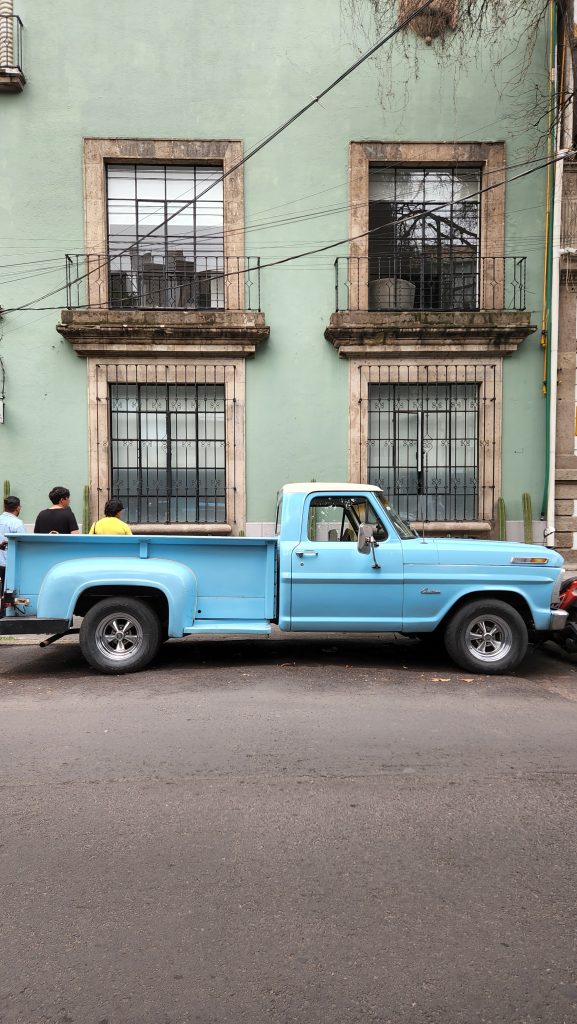
One of the things I remember most about Mexico City wasn’t a restaurant, a landmark, or even a particular neighborhood.
It was the cars.
Walking through the city, I kept noticing them. Old pickup trucks. Boxy sedans. Vans that looked like they belonged to another decade. Some were bright and colorful. Others had faded paint, mismatched panels, old wheels, dents, scratches, and all the little imperfections that come with a vehicle that has clearly lived a life.
But the interesting part was that they were still living it.
These weren’t vintage cars being pulled out of a garage for a Sunday drive. They weren’t sitting behind ropes at a car show with someone polishing the chrome.
They were working.
Some were hauling things. Some were parked along neighborhood streets. Others were moving through Mexico City traffic alongside newer cars, motorcycles, buses, and delivery vehicles. You could look down a street and see something that would probably turn heads at a vintage car meet back home simply being used as transportation.
And I loved that.
Old, But Not Retired
In America, we have a particular relationship with old cars.
Eventually, a vehicle seems to cross an invisible line. It goes from being an old car to being a classic. Once that happens, we start thinking about originality, restoration, resale value, matching numbers, factory paint, and whether somebody ruined it by changing the wheels.
Mexico City made me think about that completely differently.
Many of the older vehicles I saw didn’t appear to exist for nostalgia. They survived because someone kept them alive.
Something breaks. You fix it.
The paint fades. You repaint it.
A seat tears. You repair it.
A part becomes difficult to find. You figure something out.
Over enough years, the vehicle becomes a collection of decisions made by the people who owned it.
That might mean a different shade of paint on one panel, updated upholstery, replacement trim, hand-painted lettering, or modifications made simply because they were practical.
Instead of destroying the history of the vehicle, those imperfections become the history.
A Different Kind of Vintage Car Culture
Mexico has also long been a destination for used vehicles coming south from the United States. Combine that with a culture where repairing something can make more sense than replacing it, and you end up with an interesting middle ground.
These vehicles aren’t necessarily preserved as collectibles.
But they aren’t disposable either.
They just keep going.
That was probably what fascinated me the most.
Back home, I’m accustomed to seeing vintage vehicles in very specific environments. Car shows. Garages. Weekend meetups. Maybe cruising down the highway on a perfect Saturday afternoon.
In Mexico City, automotive history can still be part of everyday life.
The old truck you’re admiring might be delivering somebody’s supplies.
The vintage-looking sedan passing you might simply be somebody’s ride home.
The van with faded paint and decades of wear might still be earning its keep.
There is something beautiful about that.
The City Makes Them Even Better
Mexico City is already a visually layered place.
Old architecture sits beside contemporary design. Neighborhood businesses spill onto sidewalks. Signs, food stands, trees, concrete, color, music, traffic, and people all compete for your attention.
Then an old truck comes rolling through the middle of it.
It belongs there.
Not because someone staged it for a photograph, but because it is actually part of the city.
That distinction matters.
The more I travel, the more interested I become in things that haven’t been arranged specifically for visitors. Sometimes the best parts of a city are the things people who live there barely notice anymore.
For me, these cars became one of those things.
I started looking for them.
Every old grille caught my attention. Every unusual paint job made me turn around. Every time another old truck came down the street, I wondered how long it had been there, who owned it before, what had been replaced, and how many more years somebody planned on keeping it moving.
Mexico City does have regulations that affect older vehicles, including emissions requirements and the Hoy No Circula program that can restrict when certain vehicles are driven. There are also classifications for recognized antique automobiles.
But what caught my attention wasn’t the officially preserved automotive history.
It was everything in between.
The cars that were simply old enough to have stories.
Maybe That’s What I Was Actually Photographing
At first, I thought I was taking pictures of vintage cars.
Looking back, I think I was photographing something else.
Longevity.
There is a difference between preserving something so that it remains exactly as it was and preserving something by allowing it to continue being useful.
The vehicles I saw around Mexico City weren’t always perfect. That’s precisely what made them interesting.
A scratch meant the vehicle had been somewhere.
A replacement panel meant somebody decided it was worth fixing.
A strange paint color meant somebody made it their own.
A truck still carrying a load decades after it left the factory meant the story wasn’t finished yet.
I don’t know the history of every car I photographed in Mexico City.
Honestly, I think that’s part of the appeal.
I just know that in a city filled with history, some of it isn’t hanging inside a museum.
Sometimes it pulls up beside you at a red light.
